
Aboriginal School Excursions in Sydney: What Teachers Should Know
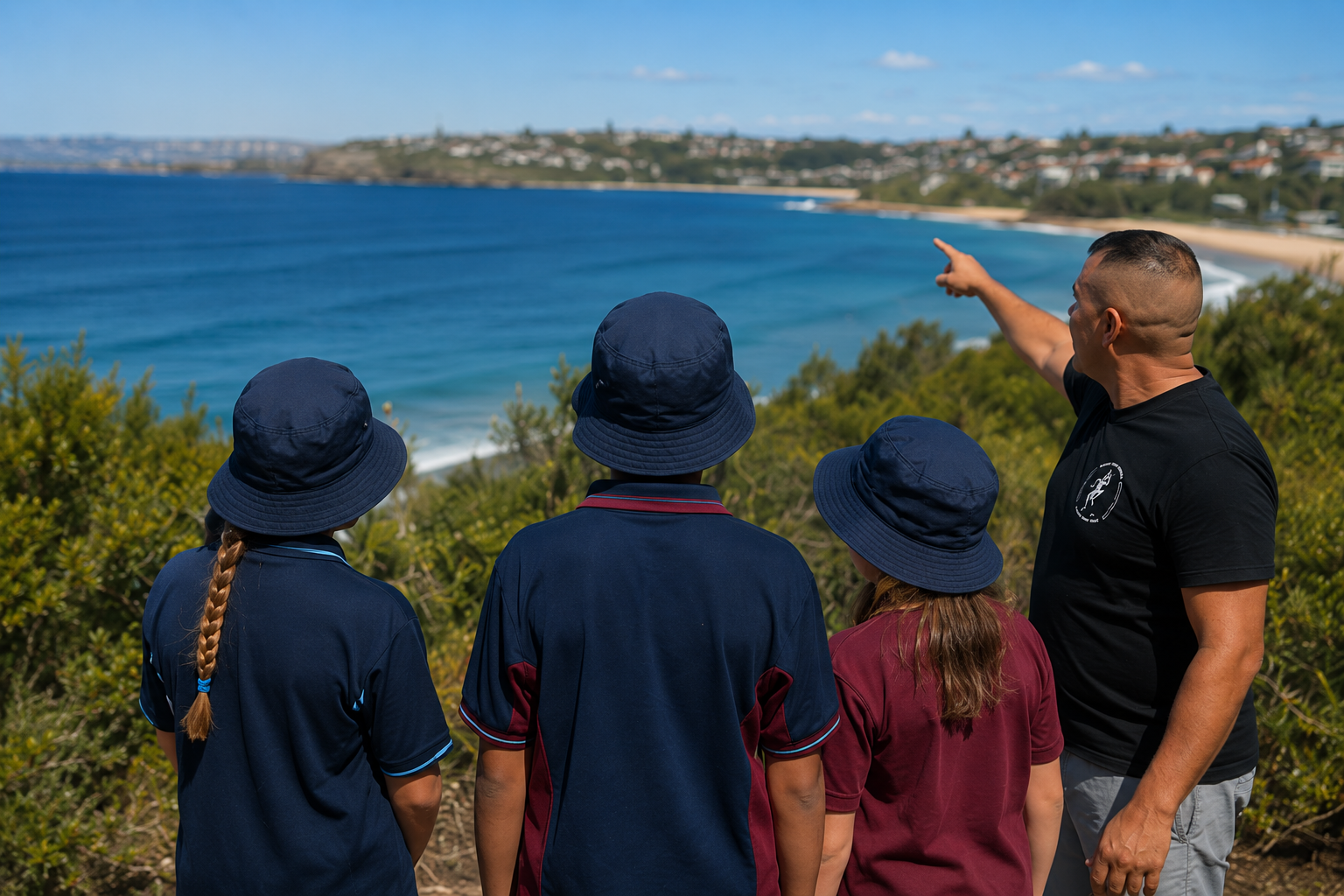
Aboriginal people have lived on the land that is now Sydney for more than 60,000 years, and the engravings, middens and shell-tool sites scattered across the city are still here, still cared for, and still teaching. For NSW teachers, an Aboriginal school excursion in Sydney is the strongest way to bring the cross-curriculum priority for Aboriginal and Torres Strait Islander histories and cultures off the page and onto Country.
This guide covers the Sydney sites where school programs run, what students engage with at each one, the Stage and Learning Area each best suits, and the cultural protocols, logistics and booking timeframes that separate a meaningful day from a forgettable one.
What Is an Aboriginal School Excursion?
An Aboriginal school excursion is a structured cultural learning experience delivered by Aboriginal educators on Country. Students travel to a significant cultural landscape and engage with Aboriginal culture through walking, story, language, hands-on activities and connection to place. The learning is led by Aboriginal guides with cultural authority, which is what makes it meaningful rather than performative.
If you want the fuller picture of how a day on Country actually runs, we cover it in our guide to what to expect on an Aboriginal walking tour in Sydney.
An excursion is not the same as an incursion, and the difference matters when you are planning.
| Aboriginal excursion | Aboriginal incursion | |
|---|---|---|
| Where it happens | On Country, at the cultural site | Inside your school |
| What students get | Direct connection to the landscape and the culture embedded in it | Cultural learning brought into the classroom |
| Typical format | Guided walk, story and hands-on activity on Country | Workshop, performance or in-class session |
| Best suited to | Deep, place-based learning | Broad cultural awareness throughout the year |
Both formats have real cultural and educational value. An excursion connects students to the landscape itself and the meaning held in it. An incursion brings cultural learning into the school environment as part of wider classroom programming.
For schools that want students to experience culture in the places it belongs to, an excursion gives a depth an incursion cannot replicate. For schools building cultural awareness across a whole year, a combination of both often works well. This sits within the broader category of an Aboriginal cultural tour, adapted for a school group.
Why Aboriginal School Excursions Matter Now
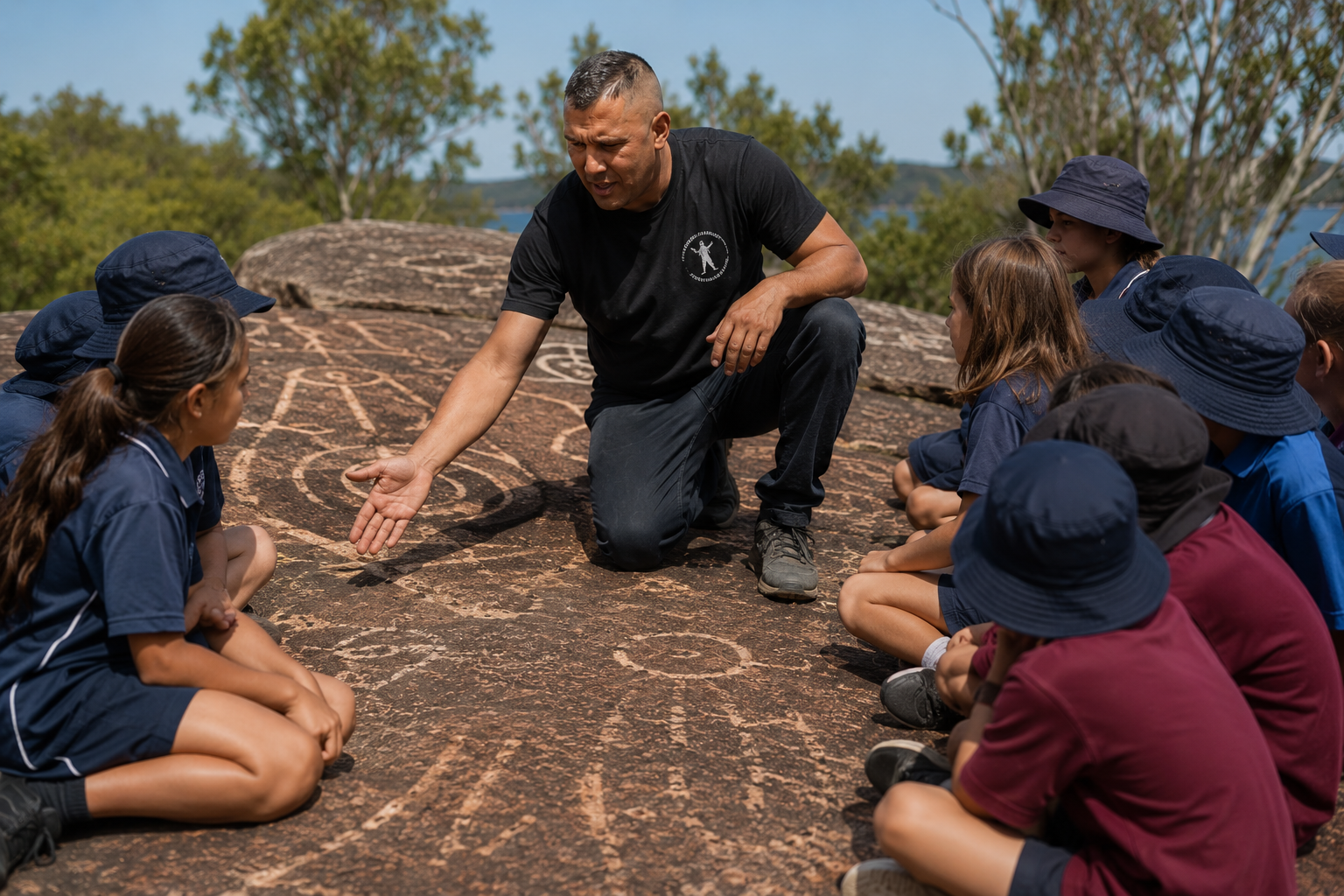
Aboriginal and Torres Strait Islander histories and cultures are a cross-curriculum priority across the NSW curriculum. The NSW Department of Education encourages public schools to work with Aboriginal community partners and the NSW Aboriginal Education Consultative Group (AECG) to embed Aboriginal cultural knowledge authentically in school programs.
The direction is clear: cultural learning is expected, and how schools meet it matters. An on-Country excursion supports this in a way classroom material cannot. Students learn culture in the places it belongs to, directly from Aboriginal educators who hold the cultural authority to teach it.
The curriculum priority is the policy reason to book an excursion. The cultural depth and student engagement are the educational reasons. Together they give a school an experience that supports syllabus outcomes and builds a real understanding of Country and the world's oldest living culture.
What Makes an Aboriginal School Excursion Worth Booking
Not every excursion delivers the same depth. Five things separate one worth booking from one that ticks a syllabus box.
1. Led by Aboriginal educators with cultural authority.
This is the most important marker. Cultural authority sits with Aboriginal educators, not with non-Aboriginal staff reading from a script. An excursion led by people who hold the culture gives students direct access to it, and it is the single biggest difference between a day students remember and one they forget.
2. Delivered on Country, not just about Country.
Cultural learning lands differently when it happens on Country. Students walk through the landscape, see cultural sites and engage with the environment as part of the lesson. The place itself is part of the teaching, which no classroom or off-site venue can replicate.
3. Age-appropriate and curriculum-aligned.
The best excursions are designed for the student's stage. Primary students do well with sensory, story-based, hands-on learning. Secondary students engage with deeper historical, cultural and contemporary content. The day should support specific syllabus outcomes a teacher can carry back into the classroom.
4. Built around hands-on cultural learning.
Students learn best by doing, not just listening. Bush food, tool demonstrations, cultural protocols in practice and storytelling on Country give them something to engage with physically and emotionally, which builds stronger memory and understanding.
5. Avoids tokenism and stereotypes.
Aboriginal and Torres Strait Islander cultures are diverse, contemporary and living. A good excursion reflects that, sharing traditional knowledge alongside contemporary Aboriginal life rather than presenting culture as frozen in the past. This matters for student understanding and for respectful representation.
Sydney Locations Suited to Aboriginal School Excursions
Sydney holds some of Australia's most significant cultural landscapes for on-Country learning. We run school excursions across four of them, and you can see the full set on ourlocations page. The table gives you a quick comparison, with detail underneath.
| Location | Best suited to | Walking | Stand-out feature |
|---|---|---|---|
| Ku-ring-gai Chase National Park | Primary and secondary | Manageable | Rock engravings and middens |
| Royal National Park | Secondary and older primary | Longer day | World's second-oldest national park, bush and coast |
| La Perouse, Kamay Botany Bay | Primary, younger students, accessibility | Shorter, easier terrain | Coastal walking and first-contact history |
| Bondi, seasonal whale experience | Primary and secondary, winter terms | Shorter | Whale migration and ocean cultural connection |
1. Ku-ring-gai Chase National Park.
One of Sydney's most culturally significant national parks, sitting on Guringai Country with one of the largest concentrations of rock engravings and middens in the region. It suits primary and secondary groups, with bushland and sandstone country making a rich cultural and ecological learning environment. Walking distances are manageable, with stops for stories, discoveries and group activities.
A strong choice for schools wanting depth and a genuine on-Country day. See theKu-ring-gai Chase walking tour for what we cover.
2. Royal National Park.
The world's second-oldest national park and one of Australia's most significant cultural landscapes, combining bushland and coastal Country with cultural and ecological learning along the way. Royal suits secondary groups and older primary students who can handle a longer day on Country, and its scale opens up cross-curricular learning across history, geography, science and culture. Details are on theRoyal National Park walking tour page.
3. La Perouse, Kamay Botany Bay.
One of Sydney's most accessible school excursion experiences, on Country connected to the Bidjigal people, combining coastal walking with cultural and first-contact history. Shorter distances and easier terrain make theLa Perouse walking tour a strong choice for primary groups, younger students and excursions where accessibility matters.
4. Bondi, seasonal Burri Burri Whale Experience.
OurBondi Burri Burri Whale Experience combines coastal walking with whale watching during the migration season, so it suits schools planning excursions in winter terms when the humpbacks are moving through. If you are timing a visit, our guide towhale watching season in Sydney sets out when and where to see them. The format is shorter and the setting dramatic, which makes it a good fit for primary and secondary groups studying coastal ecology, Aboriginal cultural connection to the ocean, or marine life through a cultural lens.
Curriculum Alignment and Educational Outcomes
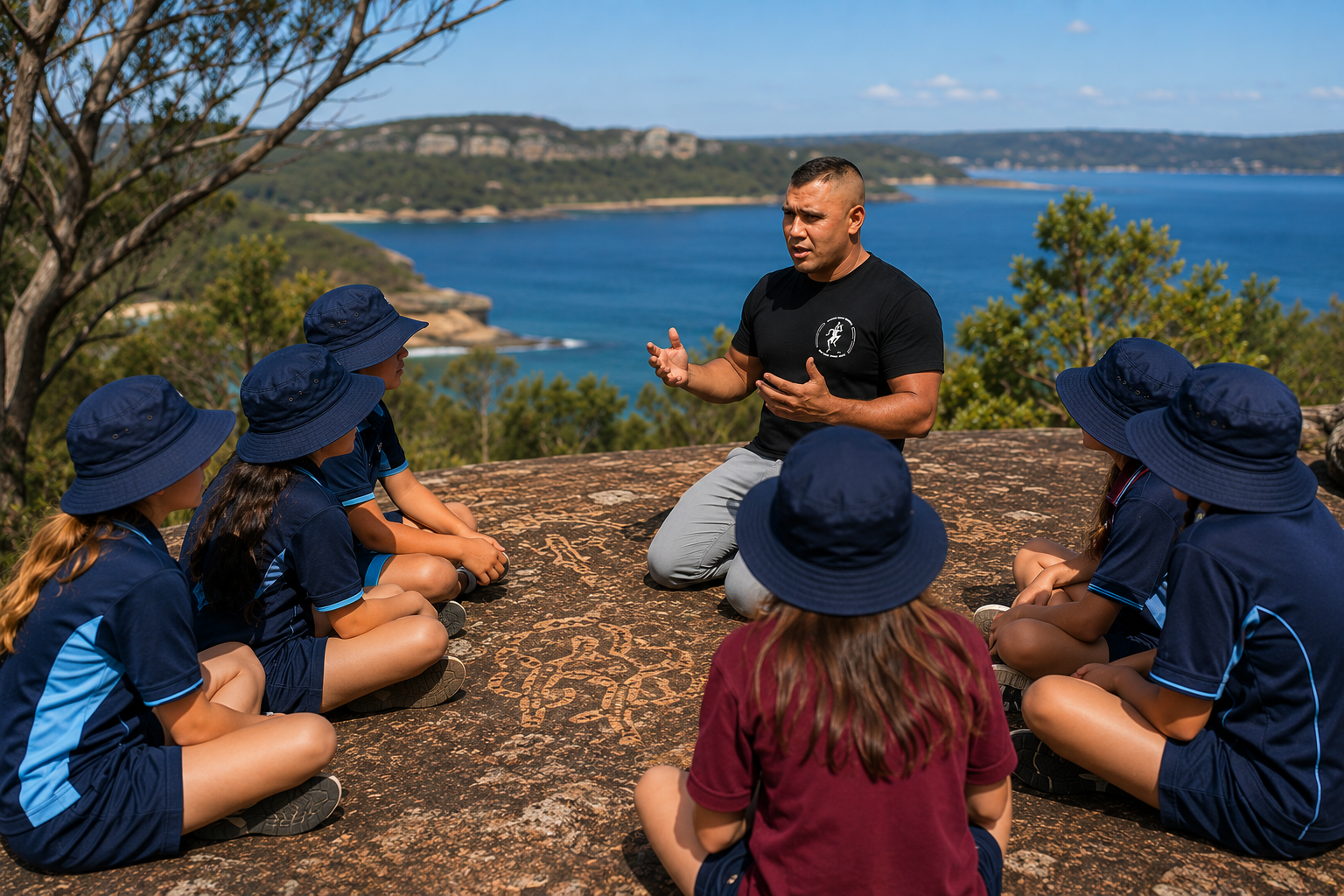
Aboriginal school excursions align directly with the NSW curriculum and support several learning areas in a single day. Four points cover the value for primary and secondary teachers.
1. The cross-curriculum priority.
Aboriginal and Torres Strait Islander Histories and Cultures is embedded across the NSW curriculum as a cross-curriculum priority. On-Country excursions support it directly, giving students first-hand engagement rather than secondary classroom material. It is one of the strongest curriculum-aligned experiences a school can offer.
2. Cross-curricular learning areas.
A single excursion can support several subjects at once. Cultural stories and history align with HSIE and English. Native plants, animals and seasonal knowledge align with Science and Geography. Cultural sites and rock engravings align with Visual Arts and History. That cross-curricular efficiency is one of the strongest justifications for the time and cost.
3. Stage-appropriate outcomes.
The best excursions are tailored to the stage. Primary students engage with hands-on, sensory and story-based learning that connects to early Stage outcomes. Secondary students work with deeper historical, cultural and contemporary content supporting Stage 4 to 6 outcomes across multiple subjects.
4. Reflection and follow-up.
The strongest learning happens when the excursion is embedded in wider classroom teaching. Plan curriculum links before and after the day to deepen the experience and meet syllabus outcomes.
Practical Considerations for Teachers Planning an Excursion
An Aboriginal cultural excursion runs on a different rhythms to a museum day. The day is led by an Aboriginal guide, the schedule is responsive rather than fixed, and the value sits in listening time. Four things to plan around.
How does an Aboriginal cultural excursion fit the NSW curriculum?
An Aboriginal cultural excursion in Sydney aligns with NSW HSIE History and Geography across every stage, and with the cross-curriculum priority for Aboriginal and Torres Strait Islander histories and cultures that runs through every Key Learning Area.
Stage 1 history draws on family stories, community and place. Stage 2 history covers First Contact and community and remembrance, with Geography content on the natural environment and how people care for it. Stage 3 brings in Australia as a nation and global connections, with First Nations perspectives on Country as foundational rather than added on.
By Stages 4 to 6, students working in History, Geography, Aboriginal Studies, and Society and Culture engage with Country, land management, cultural sites, and the long history of First Nations communities in Sydney.
The cross-curriculum priority means English, Science, Visual Arts and PDHPE units can all anchor off the same excursion with the right pre and post-visit work. When you brief the tour operator, telling them which Stage and which Learning Area you are aligning to produces a more focused day.
What cultural protocols should teachers and students prepare for?
Open with an Acknowledgement of Country, follow the guide's lead on what to photograph and what not to, and frame the day for students as listening first and recording second.
Acknowledgement of Country at the start of the day, delivered by a student or the lead teacher, sets the tone and gives students a working model they can use back in the classroom. Photography and recording protocols vary by site and by operator. Some rock engravings are not photographed. Some stories are not recorded.
The right answer is to ask the guide at the start and let students know the rule for the day before phones come out. Encourage questions rather than note-taking during yarning sessions. The format is conversational, not lecture-based, and students get more out of it when they listen first and write later.
If your school is working through a Reconciliation Action Plan, an excursion is a chance to connect that classroom work to a real place and real Custodians.
What are the day-of logistics teachers should plan around?
Most Sydney Aboriginal cultural excursions are outdoor, between 1.5 and 3 hours long, and run rain or shine, which sets the dress code and the bus plan.
Plan for enclosed walking shoes, hats, sunscreen, water bottles, layers in winter, and wet weather gear in shoulder seasons.
Many sites sit inside national parks or on harbour foreshore, so the walking surface is uneven and toilets and drinking water are at the carpark rather than at the site itself. Confirm bus access and turning circle with the operator before you book the coach, because some sites have access constraints that catch first-time visitors out (West Head in Ku-ring-gai Chase, Bare Island at La Perouse and Jibbon at Bundeena all have known coach limitations).
Standard NSW Department of Education adult-to-student ratios apply, so build that into your parent helper roster. Site-specific hazards (uneven terrain, sun exposure, water proximity) should be added to your school's normal excursion risk management template.
When should teachers book an Aboriginal cultural excursion?
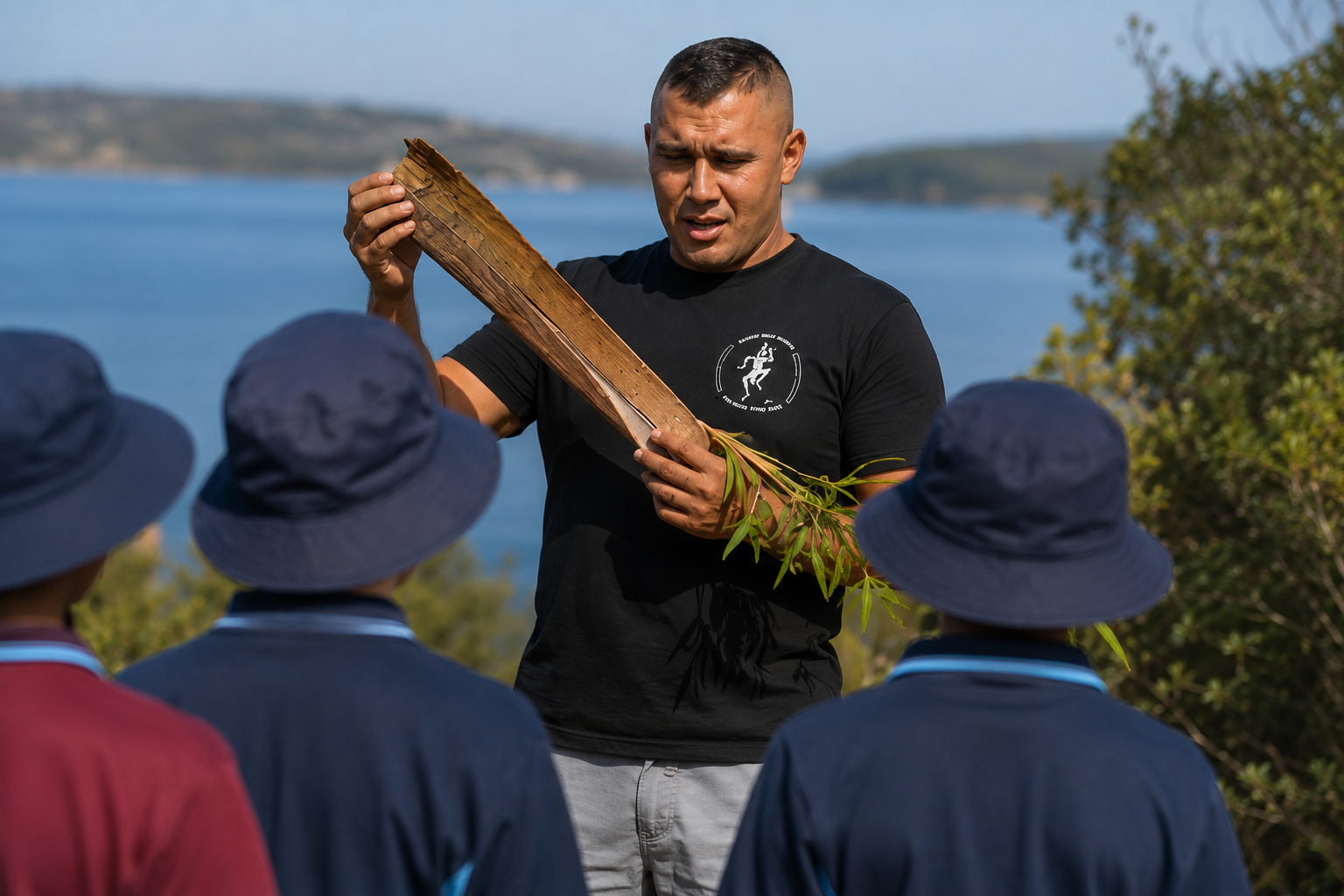
Book at least a term in advance, and earlier still if you want a date inside National Reconciliation Week (27 May to 3 June) or NAIDOC Week (early July), when Aboriginal-led operators are in highest demand.
Aboriginal-led tour operators in Sydney are a small group with limited capacity, and the calendar concentrates around the two national observances and the Term 2 to Term 3 history teaching cycles.
If your excursion is tied to a specific syllabus unit, work backwards from the assessment date so you have enough time to brief the operator on your learning outcomes, share the syllabus links, organise permission notes, complete the risk assessment and run the pre-visit lessons that make the day land.
Booking early also gives the operator scope to recommend the most suitable site for your year level rather than fitting your group into whatever date is left.
Why Choose Natcha for Your Aboriginal School Excursion in Sydney
Natcha Cultural Tours is an Aboriginal-owned operator running on-Country walking tours across Sydney's most significant cultural landscapes, including Ku-ring-gai Chase National Park, Royal National Park, La Perouse and the seasonal Bondi Burri Burri Whale Experience. I founded Natcha as a proud descendant of the Yuin, Bidjigal, Dharawal and Gundungarra peoples.
We tailor excursions to Primary and Secondary groups, with age-appropriate pacing, curriculum-relevant content and the cultural authority of an Aboriginal-owned business. Tour proceeds support theNgabul Foundation healing program for Aboriginal young people facing trauma, and Natcha is recognised by Destination NSW. For Sydney schools wanting an authentic on-Country excursion that genuinely supports student learning, that combination of cultural depth and direct experience with young people is what we bring.
Planning Your School Excursion
An Aboriginal school excursion in Sydney gives students an on-Country cultural learning experience no classroom can match. The right one is led by Aboriginal educators with cultural authority, aligned to the curriculum, and grounded in the cultural depth of Country itself.
For teachers in Sydney and NSW after an excursion that genuinely supports student learning, an Aboriginal-owned operator with real experience in school settings is the strongest place to start. That is what we offer at Natcha: on-Country walking tours across Sydney's most significant cultural landscapes, led by someone with the cultural authority and youth work background to make it count.
Frequently Asked Questions
1. What is the difference between an Aboriginal excursion and an Aboriginal incursion?
An excursion takes students out of the classroom to the cultural site, usually on Country. An incursion brings the Aboriginal educator into the school. Both have value, but only an excursion connects students to the landscape itself.
2. How do Aboriginal school excursions align with the NSW curriculum?
Aboriginal and Torres Strait Islander Histories and Cultures is a cross-curriculum priority across the NSW curriculum. On-Country excursions support it directly, with relevance across HSIE, English, Science, Geography, History and Visual Arts.
3. What ages and stages do they suit?
We tailor excursions to Primary and Secondary stages. Primary students benefit from hands-on, sensory, story-based learning. Secondary students engage with deeper historical and contemporary content. We confirm stage suitability with you when you book.
5. How far in advance should we book?
Book early. We book out months ahead, particularly in Term 2 and Term 4 when most school excursions run. Plan two to three terms ahead where you can.
7. Can the excursion be tailored to our learning outcomes?
Yes. We adapt content to support specific syllabus outcomes. Share your subject focus, stage and learning goals when you enquire, and ask about pre and post-excursion materials to extend the learning in the classroom.
8. How do we book an Aboriginal school excursion with Natcha?
Contact us to discuss your group, preferred location, dates and learning outcomes, or head straight tobook a tour. We will tailor the excursion to your stage, group size and curriculum focus.
